Search This Blog

Tuesday, April 14, 2015

FURIOUS 7

The Fast and the Furious movies have always been about family for those involved, both on and off the set. Not just blood relatives, but friends who become so close that they become more than just a friendship. The unthinkable happened when the F&F family lost actor Paul Walker in a tragic car accident during the production of Furious 7. What do you do when one of the stars of the series is down and out? As they say, the show must go on and the final result is a fitting tribute and if need be, an end to the series.

The film takes place immediately following the events of Fast & Furious 6. In retaliation for the death of one of his own, Dominic Toretto (Vin Diesel) assembles his “quasi-A-Team” of drivers to take down Deckard Shaw (Jason Statham), the brother of the previous movie’s big bad, Owen. Receiving help from a mysterious man with all of the answers (played by a very underused Kurt Russell), the team must recoup a tracking device known as “God’s Eye.” Using it, they will be able to find Shaw and keep it from falling into the wrong hands.


Diesel mumbles his way through this film, irritating me to a level I didn’t think possible, but he exudes the tough guy presence needed for a film about fast cars and stealing stuff. Toretto is the star of this film, reducing Walker’s Brian O’Connor to a supporting role. Being that this is a continuation of the previous movie, the terrible amnesia story line with Letty (Michelle Rodriguez) is still taking place in this installment. I repeat, what bogged down the last film is still happening in this one. However, part of the salvation of Furious 7 is that the best characters make a return and are the central focus of the film.

Statham’s Shaw is under-developed and evil enough to fit right at home with the rest of the brainless action. Frankly, we don’t need a backstory or good reason for him to do what he’s doing. In a movie that has cars falling out of the back of a plane, does a good motive really matter? The action sequences are truly something to behold. A chase sequence across a two-lane road throws everything including the “kitchen sink” into what’s likely to be one of the best car chases of the year. Every character is utilized perfectly but the movie doesn’t quite get up to that level again. Once you have cars flying out of a plane, it’s hard to do something that’s more spectacular.


The big question on everyone’s mind is how were the filmmakers able to work around the death of one of their lead actors? Given the cards they were dealt, the crew did an admirable job of trying to make a good movie while honoring Walker’s memory. The “smoke and mirrors” used to achieve this become very obvious during the film’s climax and in scenes involving Jordana Brewster. Most of her work was done at the end of production and had to use Walker’s siblings as stand-ins. 

As fun as this film is, it takes itself far too seriously. Dwayne Johnson gets a small amount of screen time and Kurt Russell’s Mr. Nobody is contained within act II of the film. Both actors clearly understand the subject matter and they are arguably the most fun to watch on screen. Ironically enough, they are also the two most underused characters in the cast. Luckily enough, Mr. Nobody steals the show with his very vocal love for Belgian Ale.


I fear that the magic captured in Fast 5 simply can’t be repeated again. The series’ new direction of high-octane heist movie was a thrilling and novel idea but seems to have been played out by stories that take themselves, for the most part, too seriously. How much larger can these movies get before they are ridiculous, even by their own genre’s standards?


Thursday, April 9, 2015

THE IMITATION GAME

Alan Turing was a man not many had heard of prior to director Mortin Tyldum’s film The Imitation Game. A team of code breakers, lead by the aforementioned mathematician, attempt to break a Nazi code machine during World War II using their knowledge of numbers, symbols, and patterns. However, it is Turing that realizes that technology is at a cusp in which man cannot fight a machine. Instead, another piece of technology must fight the battle.

Actor Benedict Cumberbatch as Turing delivers one of the best performances of recent memory in what’s one of the best scripts made in the last 10 years. A nearly two-hour runtime flies by thanks to the tight and masterful script from 33-year-old scribe Graham Morton (who took home an Oscar for his work).


Frequent flashbacks cut back to Turing’s time at a boarding school in which he befriends a boy by the name of Christopher. As the flashbacks reveal more and more about Turing, he inches closer and closer to building a device that will help break a Nazi machine called “Enigma,” he faces opposition from his team. Keira Knightly plays Joan Clarke, Turing’s go to confidante for all information both professional and personal. The chemistry between the two is so rich at times, you can cut tension with a knife and then turn right around and bask in the warmth of their friendship.

In the past, we’ve seen the scenario of man vs. machine play out in very physical ways with massive set pieces and explosions thanks to action movies that give us material ways of seeing these scenarios play out. The Imitation Game pits man vs. machine in an extremely intellectual fashion, yet never makes the audience feel stupid by over simplifying what the team of code breakers is doing.

Composer Alexander Desplat adds a layer to the film that won’t most notice. The score uses arpeggiating strings and rhythmic patterns that are, quite frankly, machine-like more so than they are romantic. Each note feels calculated during scenes of great technological achievement then turns to a more “heart felt” approach when the Turing deals with his inner demons and trials within his team.


The films cinematography has a classic, timeless look thanks to Oscar Faura. 35mm film gives the outdoor scenes shot on location in Bletchley Park a distinct look that can’t be replicated digitally and adds to the overall timelessness of the film. The Imitation Game is going to play well into the future come 20 or 80 years from now. Not only does the film deal with the onslaught of powerful technology, but also a social issue that many who are unfamiliar with Turing’s story will be taken aback.


Ultimately, his story is one that ended tragically, but the film chooses not to focus on that, but instead to celebrate his legacy created by a specific moment in time. Where fellow Best Picture biopic American Sniper stumbles in it’s unfocused and meandering story, The Imitation Game is a pointed, tight, and extremely well done film. The film is now available on DVD and Blu-Ray.


Sunday, March 22, 2015

IT FOLLOWS

We are living in a sweet sweet golden era of horror. What a freaking time to be alive. The Babadook haunted our bedrooms last year, The Witch comes around later this year, but right now, Robert David Mitchell's extremely well crafted It Follows stalks our suburban lives. This movie gained a lot of buzz at Fantastic Fest last year when it was awarded Best Picture in the "Next Wave"Competition category.

The film follows Jay Height (Maika Monroe), your average teenaged girl who is surrounded by friends, worried about school, and dating. She goes on a date with Hugh, a mysterious young man (Jake Weary) who chloroforms her then tires her up after a sexual encounter. She is told that something will begin to follow her. It will take the form of strangers, loved ones, family, friends, or some human form. Hugh tells her that the only way she will be able to get rid of it is to pass it along to someone else. But if Jay dies, it will go back to the person who had it prior.


This is the premise. It is simple yet at the same time, complex. The mechanics of it were a topic of discussion following the film on the ride home. Does the person who contracts the "disease" have to pass it along through genital contact? Who started it? Therein lies the super obvious moral of the story: it's a film about the spread of STD's, right? Maybe.

Director Robert David Mitchell has played the true meaning of the film pretty close to the chest not revealing what he is trying to say. At first, Jay, just as the audience, has no connection to the visions of those she sees following her. They are figures she doesn't recognize. Faces of past people who have fallen victim to "it" perhaps? Soon the faces become more familiar disorienting the audience and the characters on screen.

Maika Monroe leads one of the best ensemble casts in recent memory. Her performance is sincere and powerful as she needs to conjure virtually every emotion you can think of over the course of the film's runtime. Being an independent release, the unknown actors add to the overall experience. The actors never pull the audience out in a way that reminds us we're watching a film. Instead, they are part of the all out assault on the senses.


Adding to that assault is the electronic score by Disasterpeace. The music is so prominent and in your face at times, it seems as though the score itself is a character in the film. Pulsating electronic rhythms and sporadic tonalities create a dense pallet of sound for the ear to digest. The films' all out assault on the senses of the viewer never begin to overwhelm, but the film does become extremely heavy as act III approaches.

While horror films being churned out through the Hollywood studio system continue to prove that pop horror is in fact dead, no pun intended, indie films are offering a glimmer of hope to audiences. It Follows is a prime example of what can be achieved with a great script, top notch cast, and some vision. The major issue that puts major studio horror films to shame is a lack of vision. Directors for hire step in to direct traffic on a set, but often enough, don't have any real artistic vision. Thanks to director David Robert Mitchell, his vision has given us one of the best horror film of the last 15 years.

9/10


Monday, February 9, 2015

SELMA

Everyone recognizes the image of Doctor Martin Luther King Jr. standing in front of the Lincoln Memorial, delivering the legacy defining “I Have A Dream” speech or the photos of him standing at the front of a church delivering a sermon. History has given us an almost god-like figure in the way that he is spoken of in schools and countless other memorials in his dedication.

The greatest accomplishment of Ava Duvernay’s powerful film Selma is not its triumphant acting, cinematography or heart felt score – but the “deconstruction” of the saint-like image of Dr. King. What makes him like you or I? The answer has been right in front of us all along. He was a man. And just like any other man, he felt fear, anxiety, and great passion for assembling what eventually became the Selma Marches.


David Oyelowo delivers the performance of his career as Martin Luther King, already having received the Nobel Peace Prize, yet coming back to a racially divided Southern America shows his work is far from over. Duvernay often times places Oyelowo right in the center of the frame, drawing the eye straight to him, whether it be from directly above looking down at his head or from the point of view of people sitting in church pews.

The film’s strong suit is it’s cast. Selma has the best ensemble performance from any movie made in the last year. Tom Wilkinson paints President Lyndon Johnson not as a hero or as a villain, but as a man caught in the middle of a great struggle who is trying to be a good diplomat for what he believes to be the US Government’s best interests. Tim Roth’s take on Alabama Governor George Wallace is slimy and every bit unlikable as he came across in reality.


The daily struggle that comes with Dr. King’s work takes its toll on his marriage with Coretta (played by Carmen Ejogo), showing us a side of the man, not often discussed publicly. Paul Webb’s script does an incredible job of publicly showing us a man, who was as strong as a rock, but would turn right around and take frantic action as people coming from all over the country to participate in the Selma protests were targeted by attackers of the opposing side.


Without a doubt, this year’s Academy Award nominations were full of surprises, but Selma’s overall lack of presence among the nominees is downright shocking. Its serious subject matter begins to feel like “too much” for a film with little to no comedy by its third act. It is possible for a script to be too rich in its subject matter and as the film draws to a close, it shows. Perhaps the most important film made this side of the year 2010, Selma looks past the glorified images of Dr. Martin Luther King Jr. and examines what makes him like you and I: his humanity and the triumph, pain and passion that came with it.
10/10


Friday, February 6, 2015

AMERICAN SNIPER

The following review attempts to leave out any bias for Chris Kyle, the US Military, the Left, the Right, and focus purely on the cinematic aspects of this film. You can read my personal thoughts on the controversy surrounding the film here. 

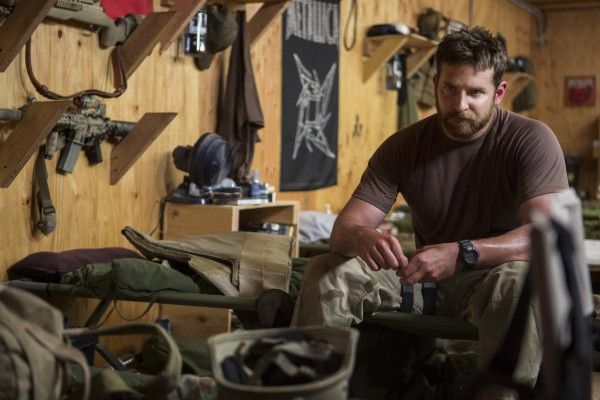
The controversy surrounding American Sniper made me extremely curious to check out Clint Eastwood’s latest film. The 84-year-old director scored the biggest box office opening of his directorial career telling the story of Navy SEAL Chris Kyle, the deadliest sniper in American Military history with 160 confirmed kills. He was tragically killed at a gun range helping a fellow veteran suffering from post-traumatic stress disorder. The film is based on his book of the same name.

Alfred Hitchcock once said that if you wanted to create suspense, an imperfect way to do so would be to have men sitting around a table and then suddenly, the blast of a bomb having been hidden beneath the table goes off. Instead, one must first see the bomb, then have the men enter the room, proceed to talk for a while, then have the explosion.

Eastwood employs the latter method in the opening of his film, showing us the moral dilemma of Chris Kyle’s first potential kill he is viewing from a perch above the action below: a child being handed a grenade to use against oncoming American troops. The film never goes any further than what is mentioned above to create true tension between Kyle and a man known as Mustafa (played by Sammy Sheik), the Iraqi equivalent of the titular American Sniper.  He is a silent killing machine that exists in the context of the film only to play spin the bullet (I’m not kidding) and conveniently kill characters necessary for the plot to move forward. 


Mustafa is a prime example of the two dimensionality of the film’s Middle Eastern protagonists. At this point in the film, I questioned whether this was done on purpose. I will never know what it's like to experience combat from the perspective of a Navy SEAL, but for those guys, it was probably a kill or be killed mentality that returned many to their families. It's rumored that when Steven Spielberg was attached to direct the project, he wanted to explore the psychological aspects of both the Chris Kyle and Mustafa, but this was unable to come to fruition due to time and budget constraints.

Sienna Miller delivers a great performance as Taya, Kyle’s wife, with the amount of material she is given to deal with. The only memorable moments in her performance are questioning why the father of her children chooses to go off to Iraq and fight an enemy thousands of miles away instead of building a relationship with his newborn children. All attention is focused on Kyle himself; after all it is his film. I found myself getting my hopes up for a psychological exploration behind the moral questions raised by killing people for his country. 


Instead, a great performance from Bradley Cooper attempted to compensate for very bland characters. There is no question about Cooper owning this film from start to finish. For those who know what the true life Chris Kyle looked and sounded like (the man appeared on a few talk shows to promote his book when it was released in 2012), it’s a no brainer why the Academy gave him his 3rd consecutive Oscar nomination for this performance. His voice is pitched differently, the characterized Texan accent is pretty darn good, and his usual trim physique is hidden beneath 225 pounds of bulk Cooper put on for the role.

One of the most striking scenes comes as a sandstorm looms on the horizon and Chris Kyle finally reaches the breaking point of servitude. Eastwood manages to cleverly sneak in a nod to the flashback within the opening of the film as he leaves behind one life for another. An impending storm means impending doom, not only because Kyle and his team are surrounded by hostile enemies, but because it is in this inescapable fate that he realizes that he didn't have to put himself through this. It is the closest we get to a look into the man's psyche, something I was dying to see instead of an Iraqi fighting against, then helping, then turning back against US soldiers. 

Instead of showing us a potentially heart breaking battle to return to normalcy once back in the US, writer Jason Hall writes off Kyle’s PTSD as a passing thought late in the third act. Again, I'm not kidding. Eastwood’s film strives for greatness, but never truly achieves or clearly gets across its Pro-Veteran, anti-war statement due to its flimsy script.

 6/10