Search This Blog

Thursday, October 31, 2013

JOHN CARPENTER'S HALLOWEEN (1978) - 31 DAYS OF TERROR

DAY 31 

A fitting end to the final day of our countdown: "John Carpenter's Halloween." A film that is largely unexplained, dark, and immensely scary. The film tells the story of Michael Myers, an escaped patient from a mental ward who is stalking baby sitters for seemingly no reason. Following his first two low budget features ("Dark Star" and the equally incredible "Assault on Precinct 13"), Carpenter honed his craft enough to make "Halloween" look like a multi-million dollar feature film. Shot for $325,000 dollars and filmed over the course of 4 weeks, the film stars Jamie Lee Curtis, Donald Pleasence, and Charles Cyphers.

On Halloween night 1963, little Michael Myers murders his older sister Judith in her upstairs bedroom of their family home in Haddonfield, Illinois. 15 years after being committed to Smith's Grove Sanitorium, Doctor Sam Loomis (Pleasence) witnesses the escape of his patient, Myers (portrayed by both Nick Castle and Tony Moran). Loomis then warns Haddonfield Sheriff Leigh Brackett (Cyphers) that Myers is returning home to kill once more. Meanwhile, we meet Laurie Strode (Curtis) and her friends Annie (credited in this film as Nancy Loomis) and Lynda (P.J. Soles). Laurie is the conservative school girl in her wild and horny group of friends. The trio will eventually meet up later that night as Laurie is babysitting little Tommy Doyle while Annie is across the street with Lindsay Wallace. However, as the night progresses, Myers - who I will refer to as The Shape, get's closer and closer to the unsuspecting girls.

The mask used in the film is actually a Captain Kirk mask spray painted white, with the eye holes cut a bit larger.

"Halloween" night was originally titled "The Babysitter Murders" by Carpenter when the film was being written. It was producer Irwin Yablans who suggested setting the film on Halloween night and changing the title to "Halloween."The film's setting is a perfect plot to device for our characters to think The Shape is just another student from their high school in a mask playing a prank on them. Their dismissal of course eventually leads to Myers having the upper hand. The Shape's mask is the perfect symbol of evil. It's so clean, pale, and white that the audience can project whatever they're afraid of onto it. Beneath the mask could be anything. The devil, a monster, or just a man. Also, it's eerie shade of white stands out against Dean Cundey's darkly lit sets, popping out against the backgrounds like one of those dead lights that Penny Wise the clown talked about in "It."

Jamie Lee Curtis in her debut gives the film a sense of legitimacy, being the daughter of legendary actress Janet Leigh, who played Marion Crane in Hitchcock's "Psycho." This film is filled with homages to the classic horror films from the Hammer company across the pond. Hell, even Donald Pleasence is in it as The Shape's doctor, Loomis. A lot of the films urgency and terror comes as a result of Loomis' dialogue, talking about Myers as nothing but pure evil. Behind his two dark eyes, is nothing, according to him. No reason, no mind, just pure evil. That is the only real explanation that Carpenter gives us as to why The Shape is stalking these girls. He IS the Boogeyman and is alive only to strike feat into the hearts of those unfortunate enough to cross his path. Charles Cyphers provides an awesome foil to the seriousness of Loomis' character. Carpenter balanced out the film perfectly. We have loose, sleazy, and fun characters like Lynda and Annie, but Laurie holds the other side of the film down. We see this throughout "Halloween."

Jamie Lee Curtis in her debut role as "Laurie Strode" in "John Carpenter's Halloween."

After you watch the picture, John Carpenter's eerie minimalistic score will stay with you long after the credits role. The score perfectly captures the simplistic essence of the film and then embodies it in 5/4 meter. The majority of popular music is in a double meter (think of a rock back beat where you can clap on 2 & 4 easily), but Carpenter's score is in a bizarre meter that feels like something isn't quite right, which they're certainly not for our characters. Most interesting is the film's third act in which Laurie finally needs to defend herself from The Shape. Yes, surprise, there's a final confrontation between our villain and heroine. Instead of Laurie cowering in a corner, she actually gets to fight back against Myers. "Halloween" does not demean women in any way. We're seeing teenagers, but the type of teenagers we're seeing are not the 80's screwball, raunchy comedy characters.

John Carpenter is an absolute master. By the time he made this film, he had come into his own as a mature, masterful, and excellent filmmaker. He toys with his audience by denying them information, then creates characters that can seemingly go at any moment on screen. His point of view shots through The Shape's eyes force the audience to be a part of his world. The breathing we hear during a montage in the film tells us that he's out there, hiding in the dark. He could be anywhere. He could be anyone, after all, Carpenter didn't give us a monster, clown, or animal mask to fear. Instead Michael Myers wears the ambiguous pale face of a man.

10/10

Rated R
Directed by John Carpenter
Written by John Carpenter and Debra Hill
Runtime - 91 minutes
Suggested edition: 35th Anniversary Blu-Ray release from Anchor Bay or the 25th Anniversary Divimax Edition for it's excellent bonus features.
7.9 of 10 stars on IMDb
94% on Rotten Tomatoes

Wednesday, October 30, 2013

JOHN CARPENTER'S THE THING (1982) - 31 DAYS OF TERROR

DAY 30

Of all of the films featured over the last month, "John Carpenter's The Thing" has a special place in my heart. It is not only one of the best all around films featured on the 31 Days of Terror, but just one of the best, period. It's a film that is dark, bleak, daring, unforgiving, and brilliantly written. Upon release, the film was passed off as another piece of sci-fi trash, Carpenter being called a pornographer of violence. However, "The Thing" is far from it.

The film finds a team of scientists at an American Antarctic research station who involuntarily become involved in a chase for an Alaskan malamute. The dog is being pursued by two Norwegian men who become killed in their attempts to catch the dog. R.J. MacReady (Kurt Russell), the camp pilot, and Copper (Richard Dysart), the camp's doctor, head over to the Norwegian outpost to find out what happened to them. Upon discovering it, they see it is badly burned. A bizarre pseudo-human corpse lays outside. Upon further research from data at the Norwegian camp, MacReady and Norris (Charles Hallahan playing the camp's geologist), discover a flying saucer buried in the ice. Based on the Norris' estimate, the ship's been buried there for about 100,000 years.  Back at the camp, the dog is kenneled along with other malamutes by Clark (Richard Masur) who is overly protective of the dogs. But upon interacting with the other animals, it transforms into a bizarre creature with tentacles, legs, and a bunch weird goo dripping from it. Blair (Wilford Brimley) performs tests and discovers that this bizarre creature is in fact eating and imitating the bodies of the life forms it consumes. The creature had been frozen in the ice for hundreds of thousands of years, only to be re-awoken by the Norwegian scientists. Now, Blair calculates that within a couple of months, should the creature get into a populated area, the entire world population would be consumed.

Kurt Russell as pilot R.J. MacReady in "John Carpenter's The Thing."

The script for the film was written by Bill Lancaster and is an adaptation of Who Goes There? a novel by John W. Campbell, Jr. Many confuse the picture to be a remake of Howard Hawkes' "The Thing From Another World", based on the same story, but the film is in fact a re-adaptation of the above mentioned novel. The script is air tight and confusing. For once, this is a good thing. The audience is never supposed to know who has been imitated and who has not. I have my own theories based on the film (to me, the shadow against the wall when the malamute is browsing the camp looks a lot like Norris). Another element of the film that was further brought out by Carpenter is its absolutely bleak view on the events happening on screen. Part of the suspense of the picture and experience viewing it was that when the characters have the drop on the creature, it never seems to work out the way I wanted it to. As the film progresses, the load on the audience becomes more and more immense as our characters have to try more and more desperately to stay alive and not be left alone with one other for they might be the thing.

Kurt Russell is stunning as MacReady. Compared to his later (and completely different) Carpenter roles, it's a marvel to watch such a talented actor on screen. His performance is always cool and calm, but never too calm. Also, I don't know if anyone else noticed this, but to me MacReady is a hair more and more on edge as the film progresses. He's obviously very level headed, being that he is the one who often has to wrangle the team together and tell everyone to calm down, but always with a sense that MacReady could snap at any moment. After a while deep into the film, my brain switched off the fact that I was watching actors on screen and I was completely absorbed into the film. Keith David is so perfect in his role that it blows my mind Carpenter that this character exists only for the purposes of this film. What I mean is that every character is rich and never feels forced or "acted." Having so many actors in one film, trapped in one place certainly makes for an interesting two hours that feel like at any time, anything can happen. Characters you expect to stay completely insane go nuts by the end of the film, people are not who they say they are, and the very humanity (literally being human) of one of the film's main characters is questioned at a point when the audience is certain that they are who they say they are.

Believe it or not, the film gets even more terrifying than a space spider coming out of someone's head.

A large part of the film's great look is thanks to Dean Cundey's masterful cinematography and lighting. Tom Atkins (star of several other Carpetner films) has called Cundey the "Master of Darkness" because of this ability to get the most interesting looking shots on screen with virtually no light when being shot. Cundey gives the arctic a rich blue hue that is then interrupted whenever we see fire on screen. Lens flares also permeate the frame from time to time, giving the film a bizarre timeless quality. Ennio Morricone's score is very minimalistic in nature in that we don't hear any melodies or things of the sort, except for the very opening cue, which is one big crescendo of sound (this cue was actually written by John Carpenter with the assistance of frequent collaborator Alan Howarth), is heard again when MacReady and Nauls (T.K. Carter) investigate a bizarre occurrence in MacReady's shack.

This movie is perfect. I do not have a single negative thing to add to this review other than reading about it will not do you any justice. The third act of the film is bleak. And for once, I'm okay with it. The film's emotional questions are never really answered. Who exactly becomes the thing at what time is very ambiguous. Carpenter sold me to the fact that this film is never about hope or defeating the thing. It's about staying alive for as long as one can. To hold out and hold on to what threads of life are attached to us for whatever short amount of time we're alive.

10/10


Rated R
Directed by John Carpenter
Written by Bill Lancaster
Based on the book by John W. Campbell, Jr.
Suggested edition: Official Blu-Ray release
8.1 stars of 10 on IMDb
79% on Rotten Tomatoes

Tuesday, October 29, 2013

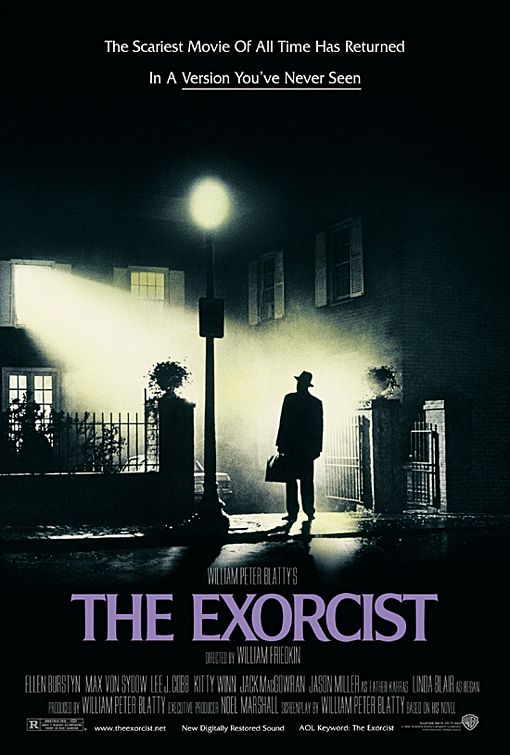
THE EXORCIST (1973) - 31 DAYS OF TERROR

DAY 29

We've seen the devil appear in various forms throughout this countdown, but none is as frightening as the interpretation of Satan in William Friedkin's "The Exorcist." This is one of those films that you weren't supposed to watch as a little kid, but we did anyway. Was this a good decision? That would depend on the person. I know someone who is absolutely traumatized by this film and can't even stand to so much as have it come up in conversation. It's that bad. But is "The Exorcist" really that terrifying of a movie? Yes it is, in every way imaginable. Friedkin presents us with a tale that is merciless, unrelenting, and every bit as terrifying as the title would suggest.

The film follows Regan MacNeill (Linda Blair) and her mother Chris (Ellen Burstyn), as strange occurrences begin to follow her day to day at their home in Georgetown, Washington D.C. Strange sounds are heard coming from the attic, Regan complains of her bed shaking, and across town, a Madonna is vandalized at a local church. Father Merrin (Max Von Sydow), a Catholic Priest on an excavation in Iraq discovers a small statue resembling the statue of a demon he defeated long ago called Pazuzu. He believes that it will return in some form. The shape it takes on is that of Regan, after she'd been communicating with someone named Captain Howdy through a Ouija board. Chris, an actress filming a movie in Georgetown, passes a seminary everyday and often sees a young priest, Damian Karris (Jason Miller). After dealing with the death of his mother, Karris has lost his faith in God. As Regan's mother becomes more and more concerned over her daughter's strange behavior, she finally takes action consulting medical doctors after seeing her bed shaking one night after a party. The doctors tell her that the solution she is seeking, is not one of medical science, but the ancient religious ritual of exorcising any sort of presence from one's body.

I don't want to ruin anything for anybody, but the characters realize that there's something terribly wrong with this girl in this scene.

How would anyone react in that situation? Even though Chris has shown Regan no religious beliefs, she spends the entire fame shouting religious profanities and taking the name of Jesus and God in vain, if you believe in that sort of thing. The first two acts of the film are her's, making her character her own and spending the time creating enough material and spouting enough dialogue to make you lover her or hate her. She is an actress and has a very social life. The party sequence in the film is the moment when Friedkin tells us that the issue plaguing Regan can no longer be ignored and it has invaded her life. Also, it's a chilling scene in which Linda Blair shows her stuff too. The charming, funny, and silly little girl we meet at the beginning of the film is completely gone. Blair has a blank face, monotoned voice, and a stare that goes straight through the camera.

I however would like to think that this film is not in fact about Regan and Chris, but instead is about Father Karris. We meet him at a point in his life in which his faith is hanging on to him by a thread and that then it is finally severed. During this trying time, he must fight the battle to end all battles. Jason Miller provides the priest with great youth and sense of direction, even though the character is lost. More often than not, I thought his character was far more interesting than the MacNeills. Karris gave me the perspective of an outsider looking in. He himself doubted the need for an exorcism and questioned the process, a fact which the audience knows in not true - the girl is possessed (after all, there wouldn't be a movie if she was imagining the whole thing).

Merrin (Max Von Sydow) begins the exorcism on Regan (Linda Blair).

Father Merrin is the great last hope. Von Sydow has an eerie vibe about him that makes my skin crawl, no matter what film I may see him in. His low spoken dialogue and weariness about everything made me feel like there really was no hope for this girl. He arrives to help her but finds himself powerless, having to band together with Karris, as does the audience. Our only hope to come out of this movie unharmed are these two men. Friedkin does something that very few directors can accomplish. During the exorcism sequence, he doesn't hold back, taking the audience hostage. Very rarely can I say that a filmmaker is dangerous and when I do, people are somewhat confused by the statement. I need only to point to this scene as an example of a filmmaker being absolutely relentless and terrifying. Well done, Mr. Friedkin. The makeup effects on this film are superb. The work was dine my Dick Smith, legendary effects man who worked on the film with fellow artist Rick Baker, who would later go on to become a legend as well. The combination of terrifying makeup effects and practical illusions add to the horror on the actors faces.

To clarify, this review is for the original theatrical cut of the film, which isn't features a different ending and alternate scenes than on the extended director's cut (which in my opinion, is just a bit better). William Friedkin's powerful direction, a powerhouse performance by Jason Miller and Linda Blair, and terrifying makeup effects by Dick Smith make "The Exorcist" an unforgettable film. It's one of those that scared the crap out of us when we were children, but we felt compelled to watch anyways because the damn thing is so terrifying. If you say that this movie doesn't scare you in the least bit, you're flat out lying.

8.5/10 


Rated R
Directed by William Friedkin
Written by William Peter Blatty
Based on the book by William Peter Blatty
Suggested edition: 40th Anniversary Blu-Ray featuring the original theatrical cut & the extended director's cut
8.0 of 10 stars on IMDb
87% on Rotten Tomatoes

Monday, October 28, 2013

SUSPIRIA (1977) - 31 DAYS OF TERROR

DAY 28

"Witch!", exclaims the vocal of Claudio Simonetti, one of the keyboard players in Goblin, the legendary progressive rock band that scored many of Italian Giallo director Dario Argento's films. Massimo Morante's guitar licks drive the hell out what we're seeing on screen: flashing lights, bright stained glass windows, and flowing downpours of violence. Witches? Violence? That can only mean one thing: Dario Argento's 1977 masterpiece, "Suspiria", starring Jessica Harper, Stefania Casini, and Joan Bennett in her final performance.

Suzy Bannion (Harper) arrives at a Dance Academy in Freidburg, Germany late at night in time to witness Pat Hingle (Eva Axén) running out in terror from the school. The next morning it is revealed that she had been expelled from the school for misconduct, yet nobody could figure out why she fled. The girl's friend Sarah, befriends Suzy, a new student coming from New York. Mysterious deaths surrounding the school begin to become more common. Bannion grows ill and the heads of the school Madame Blanc (Bennett) and Miss Tanner (Alida Valli) are of no help. When Suzy grows ill, she is put on a strict diet by the school's consulting physician. As things begin to grow more strange, Sarah realizes that Pat might have been on to something involving a coven of witches and black magic surrounding the school.
Pat Hingle (Eva Axén) barely manages to escape with her life from a mysterious force.

Dario Argento brilliantly makes this film terrifying through the usage of color and camera angles. The scene in which Suzy meets with an expert on witches and black magic films Professor Milius (Rudolf Schündler) from down low, leaving him to the right of the screen. Another excellent use of the entire frame is the scene in which Sarah is being pursued and she has to jump a small distance. Here, Argento plays a trick on us, making the audience think that she only has to jump a short distance across what appears to be some material covering the floor. This is an extremely tense and well done scene and I don't want to spoil it for anybody, but it made my skin crawl. It's the usage of angles like this in "Suspiria" that freak the audience out in addition to the films other elements such as cinematography and score.

Harper gives Suzy a sympathetic edge that many horror pictures now-a-days seem to have forgotten about. From the minute we meet Suzy, she is burdened by misfortune, not being able to hail a cab at the airport and not being able to enter the school right away. There were some scenes in the film in which Harper doesn't have to say much at all, and for once, I thought this was a great thing. Her performance was largely through her facial expressions and sincerity in her eyes. Many times throughout the film, I wished that I could step into the film and give her a hug and tell her that everything would be okay. But that would be an abso-freaking-lutely terrible idea, being that anyone that meets an untimely end in the film dies a horribly violent death.


                                  Jessica Harper as Suzy Bannion in Dario Argento's "Suspiria"


Another staple of Italian Horror pictures is the over-the-top gore and death scenes. After you watch this film, there's a hanging scene that I guarantee you won't be able to erase from your memory for a while. Bright red fake blood also adds on the intensely rich color palette that makes the whole picture seem like we're watching someone's nightmare as opposed to watching characters live out something they're actually experiencing.

The cinematography for the film was done by Luciano Tovoli. Prior to shooting, Dario Argento instructed Tovoli to watch and study the usage of color in "Snow White and the Seven Dwarfs" as that was going to be the model for the film. This movie was one of the last pictures to be developed using the technicolor process, an element which gave such American classics like "Gone with the Wind" and "The Wizard of Oz" their signature bright classic looks. Like I mentioned above, there are many scenes in which regular yellow or white light that you'd get from studio or household lights are foregone for deep reds (no pun intended), fluorescent greens, and icy blues. Not only that, but notice how at times, the doors to the different rooms seem enormous. This adds a subtle detail that at first I did not pick up on, but did feel that something was not right when characters would move through doors. This happened because as originally intended, the film's main characters were all supposed to be young 12 or 13 year old girls, but the production company would never allow a film this violent to involve children as it would probably be banned from being released. Go figure. But my point is, that the film is as visually appealing as it is entertaining.

Argento's usage of light creates beautiful contrast throughout "Suspiria."

The biggest element that struck me about the film however, was the usage of music. The score for the film was composed by Goblin (Claudio Simonetti, Massimo Morante, Fabio Pignatelli, Agostino Marangolo, and an uncredited Maurizio Guarini) and Dario Argento himself. The main theme from the film will stay with you long after you've viewed the picture (much like the hanging sequence). It's chilling, memorable, and effective. The score was written prior to the film and then played on set so the actors would be creeped out by it. How's that for your character's motivations?

At times, the script by Argento and Daria Nicolodi is weak, not making any sense or being downright stupid, but it's forgivable. This film, fitting in with other modern art, is a piece of visual art. Dario Argento gives us plenty to look at, listen to, and feel. "Suspiria" is a testament that goes to show quality over quantity is best. The characters, for the most part, are rich.  Movies like this make me a little sad because of the way that modern directors are sacrificing many cinematic elements to deliver unrelenting gore or body counts. None of that happens here, as "Suspiria" is definitely one of the best horror films of the 20th century because of it's usage of cinematography, score, acting, and suspense.

8/10


Rated X
Directed by Dario Argento
Written by Dario Argento & Daria Nicolodi
Runtime - 92 minutes
7.4 of 10 stars on IMDb
95% on Rotten Tomatoes

Sunday, October 27, 2013

CHILD'S PLAY (1988) - 31 DAYS OF TERROR

DAY 27

I believe this one is a favorite among my age group, also a film I hadn't watched since I was a little kid. I had forgotten how absolutely weird this film is! Voodoo, talking dolls, serial killers, and movie detectives that don't buy into anything (what a surprise). "Child's Play" features a cast that gives the film a weird pseudo-soap opera and melodramatic feel that makes it one of the more memorable picks for the 31 Days.

Karen Barclay (played by Lorraine Gary impersonator Catherine Hicks) buys a Good Guy doll for her son Andy (Alex Vincent). The dolls are the holiday season's hot new toy and Andy has been itching to get one. Karen buys it from a "peddler" in the alley behind her work (because that's always a good idea) but then starts experiencing strange phenomenon such as Andy talking a little too much to the doll, an accident involving her friend Maggie, and later in the film, a connection to Charles Lee Ray (played by Brad Dourif), a serial killer known as the "Lake Shore Strangler."Detective Mike Norris smells something funny and begins to investigate and keep an eye on the Barclays. Soon, Andy begins to tell Karen that the doll can speak and is alive. There's no way a doll could be alive, right?

What child wouldn't want this toy?

WRONG! Corny right? Very. The big reveal in which Chucky, the name of the Good Guy doll, reveals himself is hilarious. But it's sort of supposed to be. A big issue with the film that I had is that it teeters between winking at the audience and trying to play itself seriously. A movie like this should never try to be serious, the concept is just too ridiculous. Making it even more over-the-top is the voice work of Brad Dourif. Screaming, shouting, obscenities are all part of his tactics to shock, scare, and terrify the audience.

However a large part of what makes the film work is the performance of the young Alex Vincent as Andy. It is his performance that makes the film interesting to watch. Also, the killer doll effects. What I've been trying to say thus far, is that this is what a terrible movie is like when it's very well made. The concept is extremely corny, yes, but things like Dourif and Vincent's performance keep us interested. The above mentioned scene in which the doll reveals himself to be alive is so good. Catherine Hicks is excellent when she has to scream and shout at the doll. And how did Charles Lee Ray attach his soul to the Good Guy doll? Voodoo! That's right. Yet another element that makes this movie weirder than anything else on the countdown (maybe except "Halloween III: Season of the Witch"). It's also voodoo type witchcraft that will get CLR's soul back out of the doll, but there's a catch to it. That catch makes the third act of the film extremely thrilling and suspenseful.

Keep an ear peeled for Chris Sarandon's voice, the actor who plays Mike Norris in the film. Does he sound like anyone familiar to you (Sarandon voiced Jack Skellington, speaking, in "The Nightmare Before Christmas"). And although the film isn't strictly speaking, funny, it is the best in the series because it plays the material very straight. It channels the feel of old B-Movies from the 50's and 60's. It's a fun time. If I had to program a horror movie marathon, I would definitely pick "Child's Play" for it's interesting story, great performances, memorable villain (I know many people who were traumatized as children by this film), and no holds barred attitude.

6.5/10


Rated R
Directed by Tom Holland
Written by Don Mancini
Runtime - 87 minutes
Suggested edition - Official MGM release on Blu Ray
6.4 of 10 stars on IMDb
66% on Rotten Tomatoes